Winter in our house means one thing on repeat: somebody's sniffling. Between school germs, temperature swings, and everyone piled indoors together, seasonal illness is just part of family life. We can't oil our way out of that reality — but we've built a few simple, natural habits into our routine that we come back to every year, and we want to share exactly what we do, why, and what the research actually says about it.

A slow, seasonal morning routine
Set the expectation first
None of what follows treats, cures, or prevents illness. Essential oils and home remedies are not a substitute for a doctor or common sense hygiene. What they can do is support a body that's already looking after itself — through habits like hydration, sleep, hand-washing, and a bit of extra plant-based support during the months when everyone around you is getting sick. Think of this as reinforcing the foundation, not replacing it.
The oils we reach for — and what the research says
doTERRA On Guard is the blend we use most. It's a combination of Wild Orange, Clove, Cinnamon Bark, Eucalyptus, and Rosemary. A few points worth knowing:
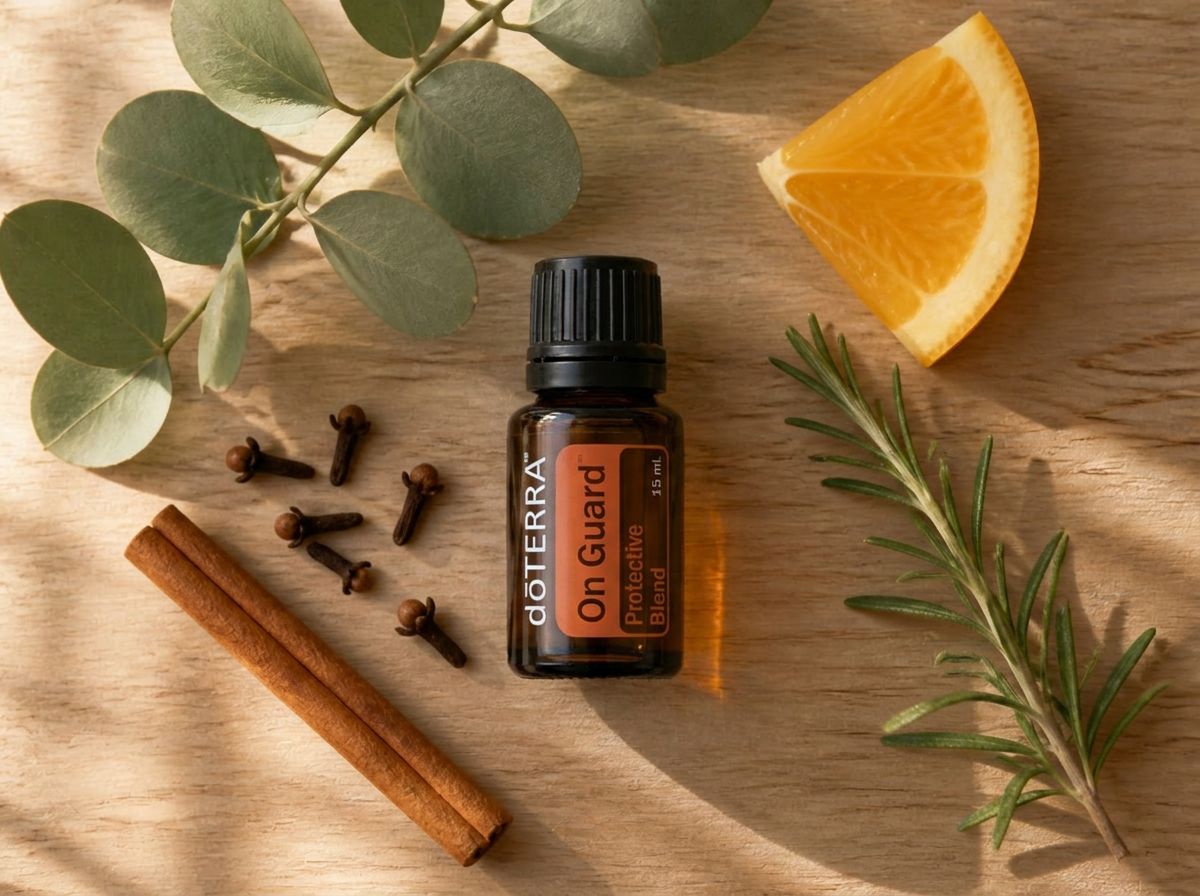
On Guard — Wild Orange, Clove, Cinnamon Bark, Eucalyptus, Rosemary
- A 2010 in-vitro study found the blend weakened influenza virus particles and reduced viral replication in lab conditions.
- A 2017 doTERRA-funded study reported the blend reduced inflammatory markers in human cells and showed effects on wound healing and immune function.
- Individually, cinnamon bark oil vapor has shown antimicrobial activity against viruses and bacteria linked to respiratory infections, and eucalyptus oil has documented immune-supporting effects.
Worth being upfront about
Several of these studies are small, in-vitro (lab dish, not human trials), and some were funded by doTERRA itself. That doesn't mean the findings are wrong, but it does mean "promising early research" is a more honest description than "proven."
How we use it: a drop of On Guard in the diffuser during flu season, On Guard beadlets when we want it without the diffuser, a roll-on for the whole family, and a single drop stirred into a big batch of elderberry syrup.
The roller option
If diffusing isn't practical — school runs, travel, or little ones who'd rather not sit near a diffuser — a roller is the easiest way to carry On Guard around. We dilute it properly rather than applying neat: for adults and older children, roughly 5 drops of On Guard topped up with Fractionated Coconut Oil (FCO) in a 10ml roller bottle works well, applied to the bottoms of the feet or the spine. This is essentially the same ratio behind our own Little Defender Roller (On Guard and Frankincense in FCO), which we make for exactly this reason. For anyone with sensitive skin, one drop of On Guard for every teaspoon of FCO is a gentler starting point.
Oregano — the one we respect rather than reach for lightly
Oregano oil gets talked about a lot in immune circles, and the research on its main compound, carvacrol, is genuinely interesting: lab studies show carvacrol disrupts bacterial cell membranes and has shown activity against bacteria including Staphylococcus aureus, E. coli, and Salmonella, as well as antiviral activity against viruses including norovirus, herpes simplex, and influenza in vitro. It's one of the more evidence-backed "kitchen cupboard" oils out there.
That said, oregano is what aromatherapists call a "hot" oil — it's a strong skin irritant undiluted, and it's not one we use casually or on children. When we use it, it's heavily diluted and adult-only (see the FLOOT roller below).
For congested little ones — Cardamom and Eucalyptus
When someone's blocked up rather than feverish, we reach for two oils in particular.
Cardamom has a gentle decongestant effect, largely thanks to its cineole content, and it's the oil we associate most with helping a stuffy baby breathe more easily. But that same cineole content means it needs real caution with little ones — it shouldn't go anywhere near a baby's face, and most safety guidance keeps topical use to around 6 months and older, properly diluted. This is exactly why our own Snuggle Breath Balm is built around Cardamom, Siberian Fir, and Frankincense, applied only to the chest and upper back, never near the nose or mouth, from 6 months.
Eucalyptus is the other classic for opening airways, and diffusing is genuinely the safer way to use it around a family — most experts consider it reasonable to diffuse around children in short, well-ventilated sessions, while direct application near a young child's face carries real risk of airway irritation due to its high 1,8-cineole content. That's actually why we deliberately leave eucalyptus out of our own baby and toddler formulas: our Snuggle Breath Balm and Breathe Easy Roller (from 2 years) both lean on gentler oils like Cardamom, Siberian Fir, and Lavender instead, so you get the "breathe easier" support without the risk that comes with eucalyptus on delicate little airways.
Our family's elderberry syrup (with a drop of On Guard)
This is the one we make every autumn without fail. We've refined it over the years to include a bit of warmth and flavour beyond the classic version — grated ginger for extra bite, fresh rosemary for a herbal note, and a scraped vanilla bean to round it out so it doesn't taste purely medicinal.
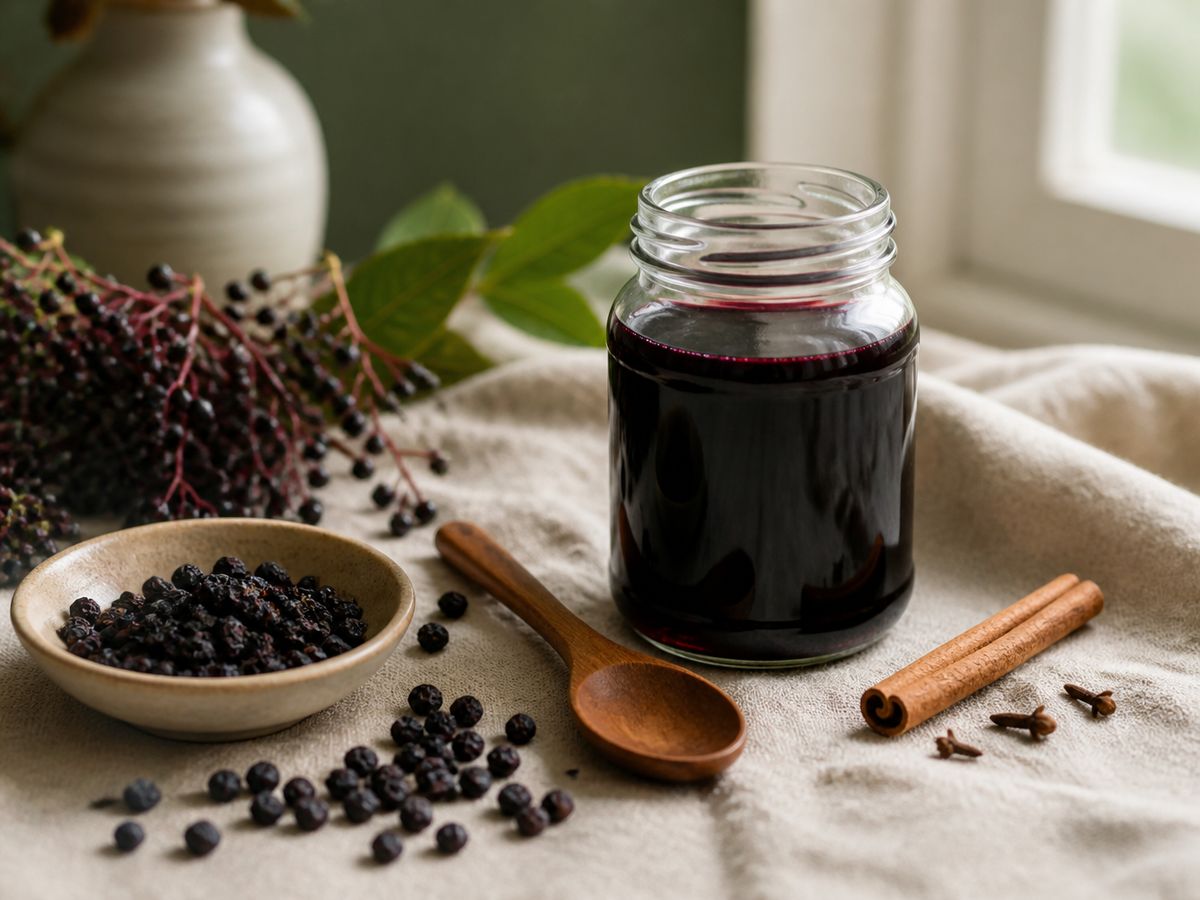
Our family's elderberry syrup
- Simmer dried elderberries in water with a cinnamon stick, a few whole cloves, a thumb of grated fresh ginger, a sprig or two of fresh rosemary, and a split vanilla bean (scraped) for about 45 minutes, until the liquid reduces by half.
- Strain out the berries, ginger, rosemary, vanilla pod, and spices, and let the liquid cool until it's warm, not hot.
- Stir in raw honey to taste once cooled (heat destroys some of honey's beneficial properties, and you don't want to cook it).
- Add a single drop of On Guard to the whole batch — not per dose, per batch — and stir well.
- Store in the fridge and use within a few weeks.
Safety notes that matter here
- Elderberries must be cooked. Raw or unripe elderberries and the plant's leaves and stems contain compounds that can cause nausea and digestive upset — this recipe only uses simmered, strained berries.
- Never give honey to a baby under 12 months old, due to the risk of infant botulism. This syrup is for children over one year and adults only.
- One drop of essential oil per batch (not per spoonful) keeps the final concentration very low and appropriate for family use — essential oils are potent, and more is not better here.
What the research says
Elderberry research is genuinely encouraging: elderberry anthocyanins have shown antiviral activity against influenza in lab studies by interfering with how the virus attaches to and enters cells, and small clinical studies suggest elderberry may shorten flu symptom duration. That said, current evidence isn't strong enough to call it a treatment — it's a supportive habit, not a substitute for a flu shot or a doctor's visit.
Fire cider (for adults)
Fire cider is the one that's just for the grown-ups in the house — it's intense, and not appropriate for kids. Our version is a variation on the traditional folk recipe:
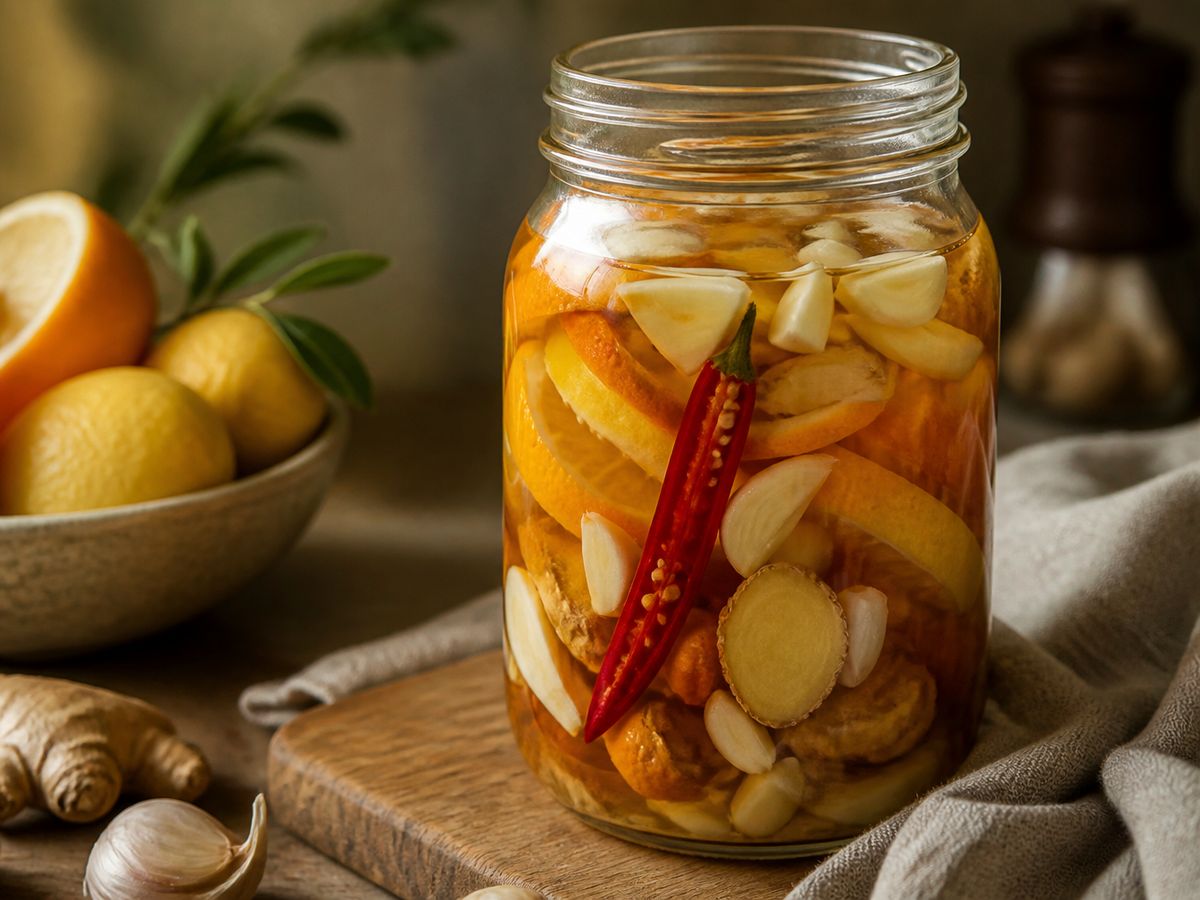
Fire cider, steeping
- Fill a jar with roughly chopped garlic, ginger, horseradish, onion, a whole hot chili, and citrus peel.
- Cover completely with raw apple cider vinegar (with the "mother"), seal, and shake.
- Steep in a cool, dark cupboard for 3–4 weeks, shaking every few days.
- Strain, and stir in raw honey to taste.
- Take a small spoonful (or a shot diluted in warm water) during the months when everyone around you has a cold.
What the research actually shows
There is no direct clinical research on fire cider as a finished product — the tonic itself hasn't been studied. But several of its individual ingredients have real evidence behind them: garlic's sulfur compound allicin has documented antimicrobial and antiviral properties, and a 2013 study found garlic combined with honey inhibited the growth of bacteria including Streptococcus pneumoniae and Staphylococcus aureus. Ginger is well-established as a safe, effective remedy for nausea and stomach upset. Apple cider vinegar has shown antibacterial effects in lab studies. In short: the individual ingredients have real science behind them, even though nobody has run a clinical trial on the finished jar of fire cider sitting in your fridge.
Because it's built on raw garlic, undiluted vinegar, and hot pepper, this one is for adults only, and anyone pregnant, breastfeeding, or on blood-thinning medication should check with their doctor before taking it regularly — garlic in concentrated form can interact with some medications.
Our FLOOT roller
This is our other adults-only immune helper — a roller we mix up ourselves, named for what's in it: Frankincense, Lemon, Oregano, On Guard, and Tea Tree, diluted with Fractionated Coconut Oil in a 10ml roller bottle. Because Oregano is a hot oil, we keep the total drop count low relative to the FCO — a small number of drops of each oil (Oregano being the smallest of the five) topped up to 10ml, applied to the bottoms of the feet or spine rather than anywhere near the face. It's built on the same "protective blend" logic as On Guard, with Oregano's carvacrol content added for extra antimicrobial punch. This one stays out of the kids' bathroom cabinet entirely — it's an adults-only roller, and like the fire cider, it's a supportive habit rather than a treatment.
A simple seasonal routine
- Diffuse On Guard in shared living spaces during the school term and flu season, especially first thing in the morning.
- Keep the elderberry syrup in the fridge from early autumn and take a spoonful daily as a family habit, not just when someone's already sick.
- Wash hands properly — this one has more evidence behind it than any oil or tonic, and it's free.
- Adults take fire cider a few times a week through the coldest months.
- Prioritise sleep — it's the single biggest lever for immune function that we control, oils or not.
Safety notes worth remembering
- No honey for babies under 12 months, in any recipe.
- Essential oils are potent — a drop per batch, never a drop per dose, and always keep bottles out of children's reach.
- Oregano is a hot oil — always heavily diluted, and adults only. The FLOOT roller is not for children.
- Cardamom and Eucalyptus should never be applied near a baby's face, and both need caution and proper dilution with young children — diffusing in short, well-ventilated sessions is generally the safer route for little ones.
- Fire cider is an adults-only remedy due to raw garlic, chili, and undiluted vinegar.
- If anyone in the family is pregnant, breastfeeding, on chronic medication, or has a diagnosed condition, check with a doctor before starting any new oil or herbal habit.
- None of this replaces medical care — if someone is genuinely unwell, see a doctor.
Ready to build your kit?
Want to put together your own family immunity kit — On Guard, beadlets, or the Little Defender roller for little ones? Message us and we'll help you get set up before the season turns.
Essential oils shared through Still Earth Living are intended for aromatic or topical use as part of a wellness lifestyle. Information provided is for educational purposes only and is not intended to diagnose, treat, or prevent disease. Always consult a qualified healthcare professional when needed.
Sources
- doTERRA On Guard Study
- Everything You Need to Know About doTERRA's On Guard Essential Oil — Healthline
- Elderberry for prevention and treatment of viral respiratory illnesses: a systematic review — PMC
- The Pros and Cons of Using Elderberry — Advanced Biomedical Research
- Fire Cider: Myth or Miracle Immunity-Boosting Tonic? — Healthline
- Fire cider: Benefits, side effects, and recipe — Medical News Today
- Garlic and Honey: Proven Benefits, Uses, Recipes, and Side Effects — Healthline
- Garlic, honey and infant botulism — Solid Starts
- A Carvacrol-Rich Essential Oil Extracted From Oregano Exerts Potent Antibacterial Effects Against Staphylococcus aureus — PMC
- Antiviral efficacy and mechanisms of action of oregano essential oil and carvacrol against murine norovirus — Journal of Applied Microbiology
- Is Eucalyptus Essential Oil Safe for Children? — Aromatic Studies
- Peppermint and Eucalyptus for children — Tisserand Institute